
Companion Plants
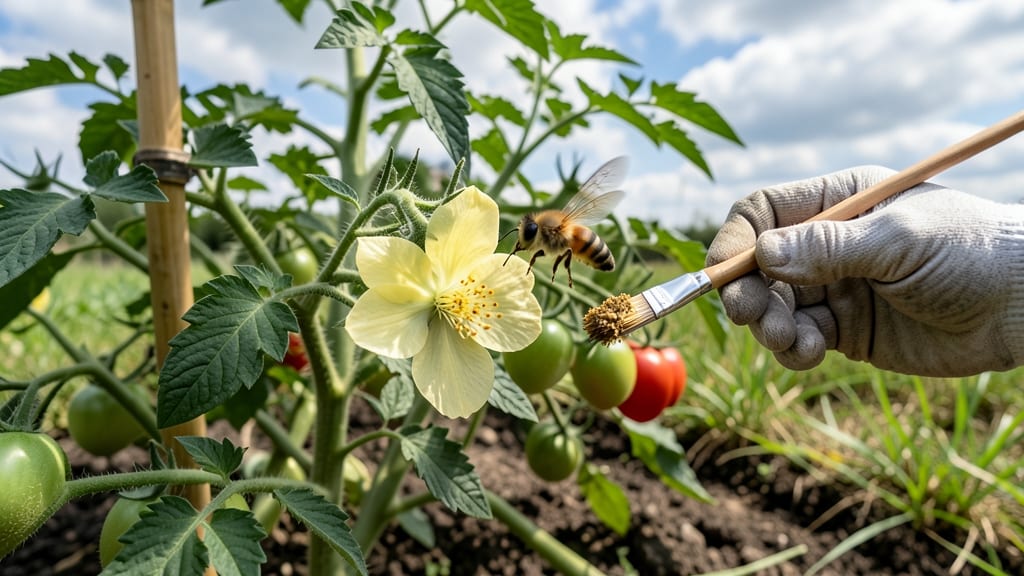
Tomato plants don't strictly need bees to pollinate, as they can self-pollinate through wind or gentle shaking, but bees dramatically improve fruit set and quality by enhancing cross-pollination.
Tomatoes are unique because their flowers have both male and female parts, allowing them to pollinate themselves when shaken or exposed to wind. 🌱 This self-pollination works well in home gardens, especially for varieties like cherry tomatoes that naturally produce abundant flowers.
However, bees play a crucial role in commercial farming by increasing the chances of successful fertilization, which leads to larger and more consistent yields. The key difference lies in the efficiency—while self-pollination works, bee activity can boost fruit production by up to 30% in some cases.
For gardeners without bees, hand-pollination is an effective alternative. The best time to do this is on calm mornings when flowers are fresh, using a small brush or even your fingertip to transfer pollen from the stamens to the stigma.
This method works particularly well in greenhouses or urban gardens where bee activity is limited. Understanding your tomato variety's pollination habits can help you choose plants that thrive with minimal intervention.
💡 In This Article
- How Tomato Flowers Self-Pollinate Without Bees
- Boosting Tomato Yield Without Bees: Manual Pollination Tips
How tomato flowers self-pollinate without bees
Tomato flowers are perfectly self-fertile, meaning each blossom contains both male (stamens) and female (stigma) reproductive parts. When the flower opens, the stamens release pollen that naturally settles onto the stigma at the center.
This process is triggered by vibration—whether from wind, gentle shaking, or even a passing bee.
The stigma then absorbs the pollen, kickstarting fertilization that leads to fruit development. 🌸 What's fascinating is how efficient this system is: studies show that 70-80% of tomato flowers can self-pollinate successfully under ideal conditions.
The key to successful self-pollination lies in timing and mechanics. Tomato flowers typically open in the morning, exposing their reproductive parts to environmental factors. The stamens are positioned just above the stigma, creating a natural "pollen shower" when the flower moves.
Even a light breeze of 5-10 mph can cause enough vibration to transfer pollen effectively. Some varieties, like cherry tomatoes, have particularly robust self-pollination rates due to their abundant flowers and compact growth habit, while larger varieties may need more assistance.
However, self-pollination isn't perfect. The natural process has limitations: pollen can become depleted after 2-3 days of flower opening, and environmental factors like humidity or temperature extremes can reduce effectiveness. This is where bees come in—they not only transfer pollen but also replenish it from fresh flowers, ensuring continuous fertilization.
In greenhouse settings where bees are absent, growers often need to supplement with manual pollination to maintain consistent yields.
Another critical factor is flower structure. Tomato flowers have a unique "bucket-shaped" stigma that collects pollen efficiently, but this design also means that only about 50% of flowers will set fruit without external assistance.
The remaining flowers may drop off if not properly pollinated, which is why you might see fewer tomatoes on plants without bee activity. This explains why commercial growers often introduce bees or use mechanical pollinators—it's not just about quantity but also about fruit quality and uniformity.
Consider this comparison: A single bee can pollinate hundreds of tomato flowers in an hour, while wind or manual methods might achieve only 10-20% of that efficiency**. The difference becomes especially noticeable in high-density plantings where flowers overlap, making cross-pollination between plants more challenging.
This is why urban gardeners with space constraints often see better results with manual intervention or bee-friendly practices.